
The Communication Institute of Greece (COMinG) organises its
6th International Conference on Education (EDU2027 )
“Reimagining Education, Leadership, and the Human in the Age of AI”
11–14 May 2027 | Epirus Region, Ioannina, The Lake Hotel, Greece.
Held in parallel with the 10th Annual International Conference on Communication and Management (ICCM2027)
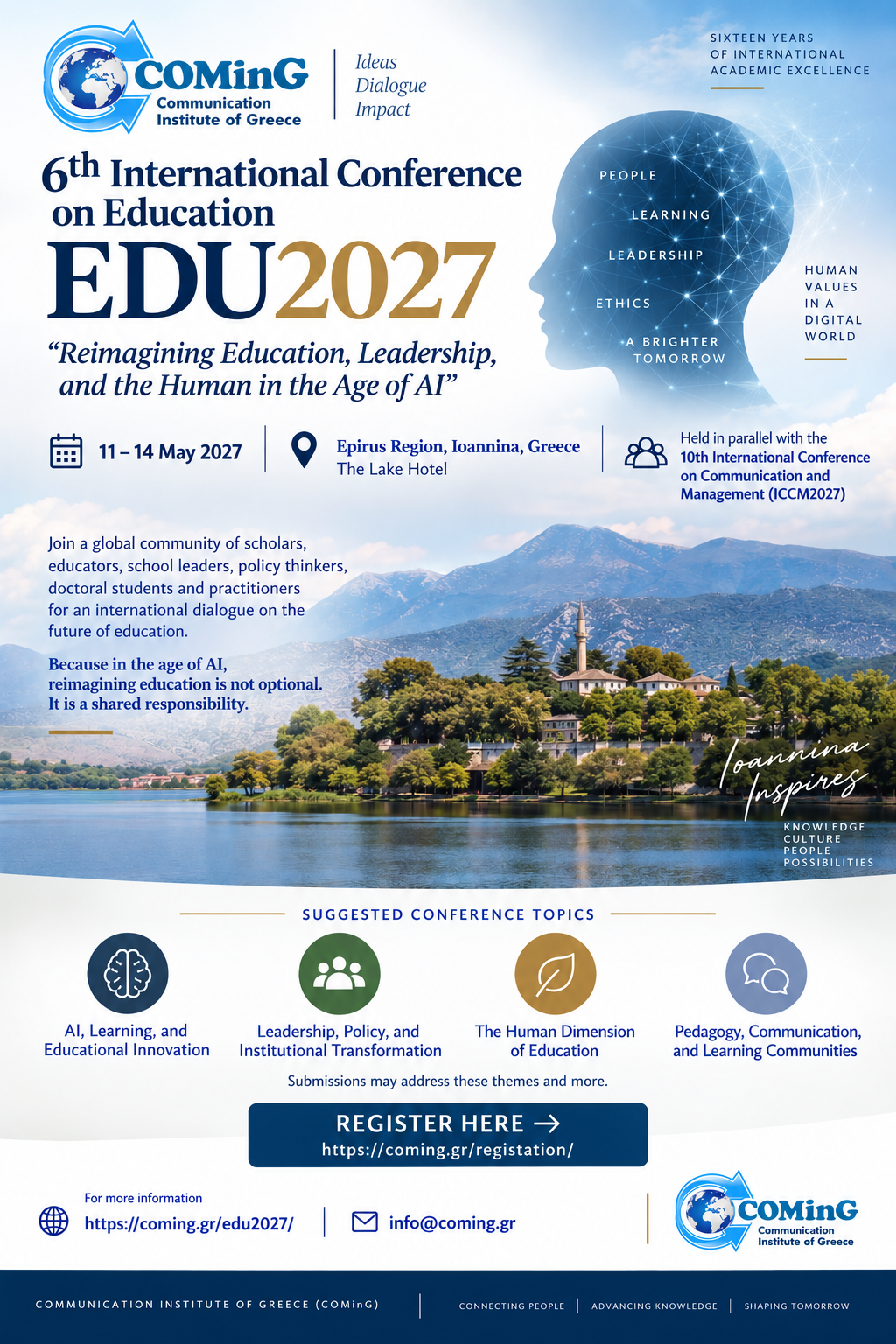
We invite scholars, researchers, educators, school leaders, policy thinkers, doctoral students, and practitioners from around the world to join an international dialogue on the future of education under the theme:
"Reimagining Education, Leadership, and the Human in the Age of AI"
At a time when education is being rapidly redefined, we invite you to join us in Greece to ask not only how education will change, but what should remain at its heart. We invite you to submit your work and become part of this international conversation. Because in the age of AI, reimagining education is not optional. It is a shared responsibility.
Held from 11 to 14 May 2027 in the inspiring region of Epirus, Ioannina, Greece at The Lake Hotel, EDU2027 welcomes contributions that examine education as a space for innovation, exchange, knowledge sharing and communication. This conference offers a platform for rigorous academic exchange and meaningful conversation around pressing questions such as:
- How is AI transforming teaching, learning, curriculum design, and educational leadership?
- How can institutions preserve academic integrity, inclusion, wellbeing, and critical inquiry while embracing digital innovation?
- What forms of leadership are needed to guide educational communities through uncertainty, complexity, and transformation?
- How can education prepare learners not only to use AI, but to live ethically, creatively, and responsibly alongside it?
As AI enters schools, universities, organizations, and lifelong learning systems, educational leadership should remain ethical, inclusive, relational, and future-oriented.
Following the organization of sixteen (16) successful international conferences, the Communication Institute of Greece invites academics, professionals, and industry experts from various fields to discuss the future directions and innovations of their discipline. Participants from previous COMinG events have often highlighted precisely this combination of high academic standards, inclusive exchange, and authentic collegiality as one of the conference’s most distinctive strengths.
Suggested Conference Topics
Submissions may address, but are not limited to, the following themes:
AI, Learning, and Educational Innovation
- Artificial intelligence in teaching, learning, and assessment
- AI literacy and critical AI education
- Adaptive learning systems and personalized education
- Generative AI in higher education and schools
- Learning analytics and data-informed pedagogies
- Intelligent tutoring systems and virtual learning environments
- AI and the redesign of curriculum
- Hybrid, blended, and flexible learning models
- Gamification, immersive learning, and emerging educational technologies
- Future classrooms and digitally transformed educational ecosystems
Leadership, Policy, and Institutional Transformation
- Educational leadership in the age of AI
- Leading schools and universities through digital transformation
- Strategic decision-making, governance, and innovation in education
- Policy responses to AI in education
- Academic integrity, authorship, and ethical use of AI tools
- Professional development for teachers and academic staff
- Change management in educational institutions
- Quality assurance and evaluation in technology-enhanced education
- Internationalization, collaboration, and global education leadership
- Equity, access, and inclusion in digitally transformed institutions
The Human Dimension of Education
- Human-centered and holistic approaches to education
- The role of empathy, dialogue, ethics, and care in learning
- Student mental health, wellbeing, and belonging
- Teacher identity, agency, and emotional labor in times of change
- Creativity, imagination, and the arts in AI-shaped education
- Critical thinking, media literacy, and digital citizenship
- Values education, civic education, and democratic participation
- Intercultural education and global citizenship
- Inclusion, diversity, and social justice in educational environments
- Education for meaning, purpose, resilience, and flourishing
Pedagogy, Communication, and Learning Communities
- Teacher-student communication in digital and AI-mediated environments
- Communication, feedback, and relational pedagogy
- Collaborative learning and communities of practice
- Classroom culture, trust, and engagement
- Family-school-university partnerships
- Communication strategies for educational leadership
- Language education, multilingualism, and communication technologies
- Storytelling, reflection, and narrative in teaching and learning
- Lifelong learning, adult education, and professional education
- Informal learning, non-formal education, and community-based education
Research, Society, and Futures of Education
- Philosophical and ethical perspectives on AI and education
- Comparative and international education research
- Sustainability education and the future of learning
- Education, work, employability, and future skills
- Research methodologies for studying AI in education
- The future of the university and the future of the school
- Educational futures, speculative thinking, and scenario planning
- Interdisciplinary perspectives connecting education, communication, management, and leadership
Venue and Dates
EDU2027 – 6th International Conference on Education
- The Conference: 11–14 May 2027
- Location: Epirus, Ioannina, The Lake Hotel , Greece
Deadlines and other information
- Abstract submission deadline: 25 October 2026
- Full paper submission deadline: 15 April 2027
- *Provisional conference program
- *Social and Educational Program
- *Scientific Committee
- *Conference Endorsers
Held in parallel with:
ICCM2027 – 10th Annual International Conference on Communication and Management
Theme: Reimagining Communication and Leadership in the Age of AI
Together, these twin conferences create an interdisciplinary meeting point for those who seek not only to understand change, but to shape it responsibly.
Set in the remarkable landscape of Epirus and Ioannina, EDU2027 offers more than an academic program. It offers a setting that encourages reflection, dialogue, and intellectual exchange—where ideas can be discussed not only in formal sessions but also in the informal moments that often spark the most lasting collaborations.
Conference Formats
EDU2027 include:
- in-person and online presentations
- thematic panels and paper sessions
- interdisciplinary exchange with parallel ICCM2027 sessions
- opportunities for networking, collaboration, and publication-oriented discussion
- To present a paper, please send your abstact using the Abstract template to registration@coming.gr, in .doc file
OR see other submission formats. - REGISTER HERE
Why Participate in EDU2027?
EDU2027 is designed not only as a conference, but as an intellectual meeting space—a place where research meets reflection, innovation meets responsibility, and international scholarship meets genuine human connection.
Participants will have the opportunity to:
- present their research in an international and interdisciplinary setting,
- engage in meaningful dialogue with scholars from different countries and academic traditions,
- explore emerging questions at the intersection of education, leadership, ethics, and AI,
- connect with colleagues in a conference atmosphere known for its academic seriousness, openness, and cultural warmth,
- contribute to a wider conversation on how education can remain deeply human while becoming more technologically responsive.
Who Should Submit?
We warmly welcome submissions from:
- academics and researchers
- university faculty and postdoctoral scholars
- doctoral and postgraduate students
- school leaders and educational administrators
- teachers, trainers, and curriculum designers
- professionals working in educational technology, policy, communication, and leadership
- interdisciplinary scholars interested in the future of education and society
Publication Opportunities:
All accepted abstracts will be published in the conference proceedings online with ISBN (abstract book of the conference proceedings).
Selected papers, following the peer review process, may be considered for publication in one of the following journals:
*Journal of Education, Innovation and Communication (JEICOM)
*Journal of Applied Learning & Teaching (JALT)
*Strategy and Development Review
Information and Inquiries
For conference details, participation information, and updates, please visit: www.coming.gr
For further information: info@coming.gr
*Provisional conference program
*Social and Educational Program
The Communication Institute of Greece (COMinG) was first established in 2003 in France. Based in Greece since 2013, this independent academic association aims to provide a forum where academics, researchers, professionals, and friends from all over the world can meet to exchange ideas on their research and discuss future developments in their disciplines. To become a member and contribute to the Institute’s objectives, please send an email to Dr Kefalaki Margarita at president@coming.gr